
Medical full-body composition scan with DEXA
Medical body composition scan in Graz – measuring body fat and muscle mass precisely
Self-pay, no referral needed · €70
Scales only show your weight. A DEXA body composition scan shows how your body is made up of fat mass, lean mass and bone mineral – including how these are distributed across different regions of your body.
See what's really changing: fat, muscle mass, or both.
- Medically precise measurement
- Regional analysis
- Ideal for monitoring changes over time
What does a medical body composition scan show?
Whether you want to measure your body fat or have your muscle mass measured: the body composition scan shows what your weight is made up of and where it is distributed – not just how much you weigh.
Fat mass
How much of your body weight consists of fat – as a percentage and in kilograms.
Lean soft tissue mass
Everything that is neither fat nor bone – including muscle.
Bone mineral
The mineral content of the skeleton as part of body composition.
Lean mass is not the same as muscle mass. Lean soft tissue mass serves as an approximation for muscle mass. Muscle strength and muscle quality are not measured directly.
Schematic illustration – no measured values, no proportions.
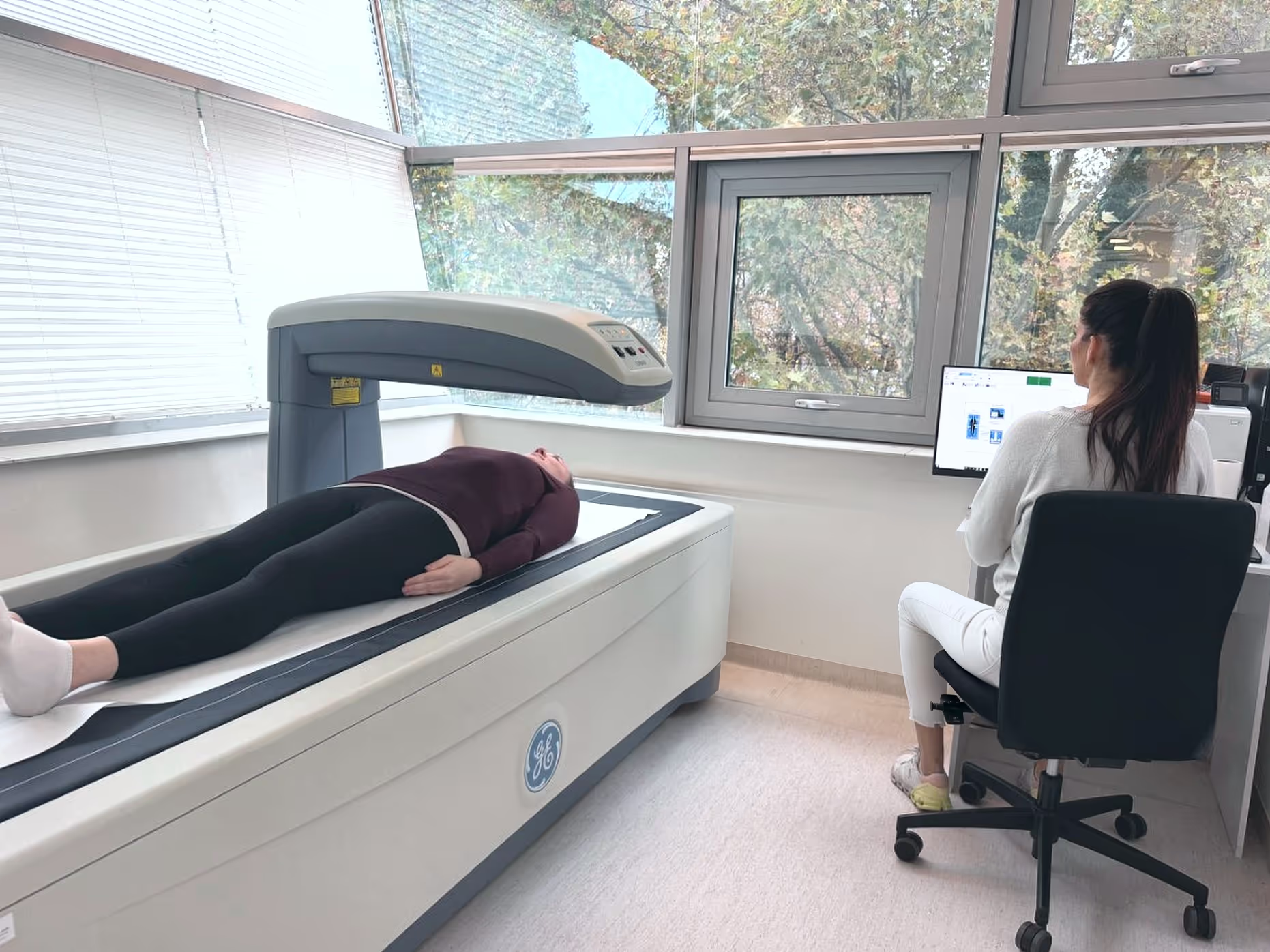
For this, we use the medical DEXA method (dual-energy X-ray absorptiometry). You lie still on the examination table while the device scans your body using two very low-dose X-ray energies. Because fat, fat-free tissue and bone absorb these energies differently, they can be distinguished from one another.
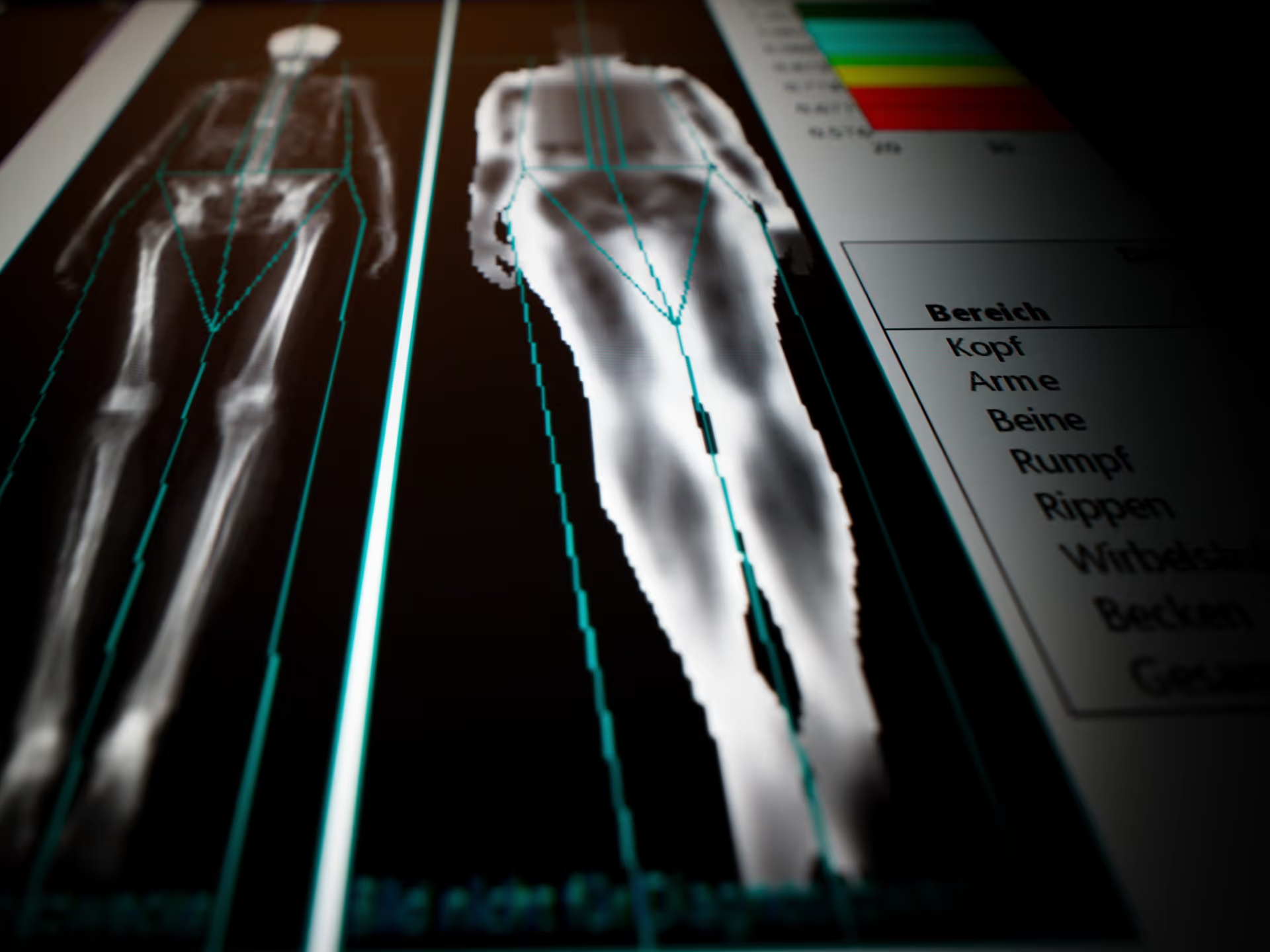
Body fat percentage and total fat mass
How much of your body weight consists of fat – as a percentage and in kilograms.
Fat-free, or lean, soft tissue mass
Everything that's neither fat nor bone – including muscle. This value serves as an approximation of your muscle mass.
Distribution across arms, legs and trunk
Where fat mass and lean mass are located – assessed separately for each body region.
Left-right comparison
Differences between the left and right sides of the body, for example after an injury or with one-sided strain.
Bone mineral content
The mineral content of the skeleton as part of your overall body composition. It does not replace a bone density scan.
Comparison with later follow-up measurements
Follow-up scans show whether fat, muscle mass, or both have changed.
Muscle mass – precisely defined
Strictly speaking, DEXA measures lean, or fat-free, soft tissue mass. This is used as a reliable estimate of muscle mass. Muscle strength and muscle quality are not measured directly.
DEXA makes visible what body weight and BMI cannot distinguish.
In addition, our device's software evaluates visceral fat (fat around the internal organs in the abdomen).
What a scan report looks like
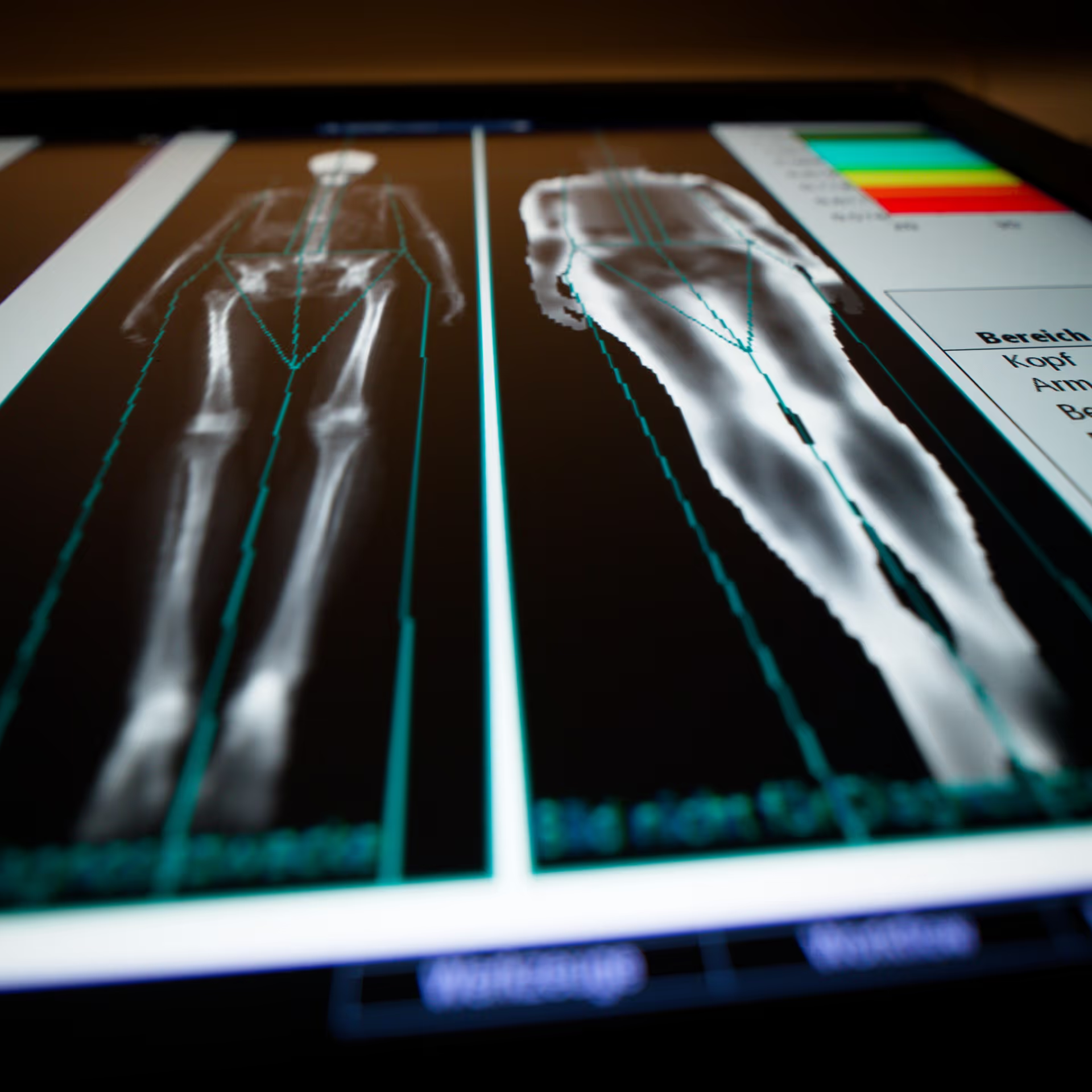
Browse through an anonymised example report to find out what each measurement means.
The values shown are an example. Individual assessment takes into account age, sex, body build and the medical question being investigated.
Sources for the explanations
- Chaves LGCM, Gonçalves TJM, Bitencourt AGV, Rstom RA, Pereira TR, Velludo SF. Assessment of body composition by whole-body densitometry: what radiologists should know. Radiol Bras. 2022;55(5):305–311. doi.org/10.1590/0100-3984.2021.0155-en (opens in a new window)
- Ofenheimer A, Breyer-Kohansal R, Hartl S, et al. Reference values of body composition parameters and visceral adipose tissue (VAT) by DXA in adults aged 18–81 years – results from the LEAD cohort. Eur J Clin Nutr. 2020;74:1181–1191. doi.org/10.1038/s41430-020-0596-5 (opens in a new window)
Who can benefit from a DEXA body composition scan?
Treatment with a weight loss injection
Baseline scan and follow-up monitoring during medically supervised treatment.
Fitness and muscle building
Assess training progress more objectively, even if your body weight barely changes.
Endurance and competitive sport
Document body composition and regional distribution over time.
Menopause and healthy ageing
Detect changes in fat distribution and muscle mass at an early stage.
Muscle loss and sarcopenia
Assess low muscle mass as part of further medical evaluation.
Weight loss and weight-loss injections
Losing weight: are you losing fat – or also valuable muscle mass?
The scales only show the overall change in weight. With significant weight loss, both fat mass and fat-free mass can change. A DEXA body composition scan objectively documents this development.
This may be relevant to you if …
- You are changing your diet.
- You are taking medically prescribed GLP-1 or GIP-based medication.
- You are about to undergo, or are in the middle of, significant weight loss.
- You want to reduce fat while preserving as much muscle mass as possible.
Not a check on medication dosage
The scan documents your body composition. It is not used to check medication dosage. Any changes to drug treatment are made solely by your treating doctor.
How the follow-up scan works
Baseline measurement at the start
The first scan records your body composition before or at the start of weight loss.
Follow-up measurement after a medically appropriate period
Often after several months. The right interval depends on your individual progress.
Clear comparison of results
The report compares the values: how have your fat mass and fat-free mass changed?
Making training progress visible
Increased muscle mass and reduced fat can develop at the same time. This means your body can change significantly even though your weight on the scales stays almost the same.
A body composition scan makes these changes measurable – helpful for:
- Strength training and muscle building
- Endurance sport
- Starting or changing your training
- Long-term fitness programmes
- Objective before-and-after comparisons
What DEXA does not measure
DEXA documents body composition, but measures neither muscle strength nor endurance nor athletic performance. The examination itself does not improve performance.
Three options for your measurement
Baseline scan
Your baseline values at the start – the reference point for all later comparisons.
- Price
- €70
Single follow-up scan
A follow-up scan, compared with your most recent scan.
- Price
- €70
Baseline and follow-up package
Two body composition scans: a baseline scan and a later follow-up scan at a package price – both scans within 2 years.
- Price
- €130
- Interval between measurements
- depending on training volume and goal
- Validity
- Both scans within 2 years
You can pay by cash, card or invoice.
Measuring comparably
Follow-up measurements are most meaningful when carried out on the same device and under comparable conditions where possible: for example at a similar time of day, after fasting for 3 hours and with an empty bladder.
Identifying muscle loss and sarcopenia early
Sarcopenia refers to a progressive loss of muscle strength and muscle mass. The risk increases with age, among other factors, but can also be influenced by prolonged inactivity, illness, malnutrition or significant weight loss.
Possible signs
- Decreasing strength
- Difficulty standing up or climbing stairs
- Repeated falls
- Unintended weight loss
- Prolonged immobility or hospital stays
- Significantly reduced physical capacity
The role of DEXA
DEXA can be used to determine the lean mass of the arms and legs. Your report includes the RSMI calculated from this – an index of the lean mass of the arms and legs in relation to height.
Important
DEXA alone cannot confirm or rule out sarcopenia. A complete assessment also includes muscle strength, for example grip strength or a chair-stand test, and, if necessary, physical performance. This assessment is carried out by your treating doctor.
DEXA, body fat scale or BIA – what's the difference?
Body weight / BMI
- What the method shows
- Shows your weight, or the ratio of weight to height.
- Good to know
- Does not distinguish between fat mass and muscle mass.
Body fat scales / BIA
- What the method shows
- Estimates body composition using electrical resistance and calculation models.
- Good to know
- Results can be affected by factors such as the device, algorithm and fluid balance. For comparisons, it is best to always use the same device under similar conditions.
DEXA
- What the method shows
- An established clinical reference method that is very precise and highly reproducible.
- Good to know
- Provides a regional breakdown of fat mass, lean soft-tissue mass and bone mineral content – well suited to standardised follow-up scans.
| Method | What the method shows | Good to know |
|---|---|---|
| Body weight / BMI | Shows your weight, or the ratio of weight to height. | Does not distinguish between fat mass and muscle mass. |
| Body fat scales / BIA | Estimates body composition using electrical resistance and calculation models. | Results can be affected by factors such as the device, algorithm and fluid balance. For comparisons, it is best to always use the same device under similar conditions. |
| DEXA | An established clinical reference method that is very precise and highly reproducible. | Provides a regional breakdown of fat mass, lean soft-tissue mass and bone mineral content – well suited to standardised follow-up scans. |
Body fat scales and BIA devices are practical, widely available and can give helpful pointers for everyday use. DEXA provides more detailed medical information: the method separates fat, fat-free soft tissue mass and bone mineral, evaluates each body region individually and delivers highly reproducible results – making it particularly suitable for standardised follow-up measurements.
Bioimpedance is not bioresonance
Bioimpedance (BIA) and bioresonance are different methods. A bioresonance treatment does not replace a quantitative DEXA body composition scan.
How your body composition scan works
Choose your appointment
Book your appointment directly online or call us on 0316 840 90 50.
Brief preparation
- Please come on an empty stomach: do not eat anything for 3 hours before the scan. Drinking water is fine.
- Please empty your bladder immediately before the scan.
- Wear light clothing.
Metal items in the scan area – such as belt buckles, zips, buttons or jewellery – can interfere with the measurement. Please let us know before the examination if you might be pregnant.
No DEXA scan is carried out directly after an examination with contrast medium. According to the manufacturer, the scanning table is designed for a body weight of up to 159 kg – if your body weight is very high, please check by phone in advance whether the scan is possible.
DEXA whole-body scan
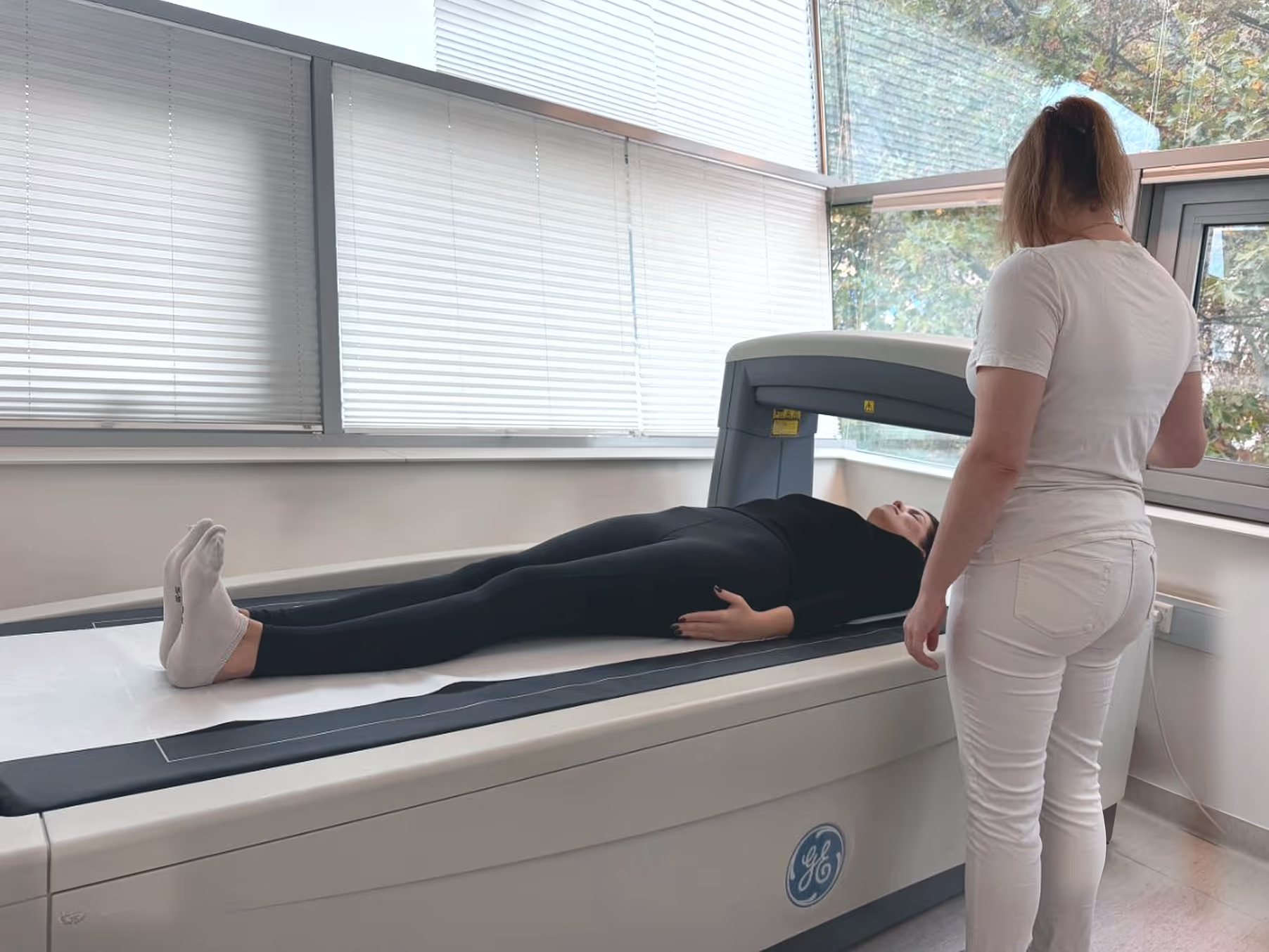
You lie still on the examination table while the device scans your body. The examination is painless. Please allow around 20 minutes for your appointment.
Schematic illustration: The scan arm moves over the whole body. The bone, lean mass and fat tissue are then analysed separately.Video content as text
The scan: The scanning arm moves from head to toe – with a very low radiation dose.
The analysis: Bone mineral content, lean soft tissue mass (including muscle and organs), fat under the skin (subcutaneous fat) and visceral fat in the abdomen are shown separately.
Schematic illustration – not an actual patient scan.
Easy-to-understand results
You will receive a clear report with your results and how they are distributed across the body regions. An in-person consultation with a doctor is not included with a body composition scan. If you have any medical questions, please contact your treating doctor.
You will receive your report via the patient portal; it is also available in ELGA.
Low radiation dose
DEXA uses a very low X-ray dose. Even so, you must tell us before the examination if you might be pregnant.
Frequently asked questions about body composition scans
A medical measurement of your body composition. DEXA (dual-energy X-ray absorptiometry) uses two very low-dose X-ray energies to distinguish between fat mass, lean soft tissue mass and bone mineral – for the whole body and separately for arms, legs and trunk.
Body fat scales and bioelectrical impedance analysis (BIA) estimate body composition using electrical resistance and calculation models. The result depends, among other things, on the device, the algorithm and your fluid balance. DEXA measures the tissues directly, provides a regional breakdown and is well suited to standardised follow-up checks.
Not directly. Strictly speaking, DEXA measures lean, or fat-free, soft tissue mass. This is used as a reliable estimate of muscle mass. Muscle strength and muscle quality are not measured directly.
DEXA alone cannot confirm or rule out sarcopenia. The scan shows the lean mass of the arms and legs. A full assessment also requires muscle strength – such as grip strength or a sit-to-stand test – and, if needed, physical performance. Your report includes the RSMI, an index of arm and leg lean mass relative to height. The assessment is made by your doctor.
Please allow around 20 minutes for your appointment. The scan is painless and you simply lie still on the examination table.
DEXA uses a very low X-ray dose. Even so, you must tell us before the examination if you might be pregnant. The exact dose depends on the device and the examination protocol.
Please come on an empty stomach (nothing to eat for 3 hours before the scan, water is fine), empty your bladder just beforehand, and wear light clothing. Metal items in the scan area – such as belt buckles, zips, buttons or jewellery – can interfere with the measurement. For follow-up scans, keeping conditions as similar as possible is important, for example a similar time of day.
There's no fixed interval for this. Changes in body composition take time, so a follow-up scan is often done after several months. The right interval depends on your goal and your individual progress. Comparisons are most meaningful when done on the same device and under comparable conditions.
No. The body composition scan is a private service and can be booked without a referral. Health insurance does not cover the cost.
The body composition scan is a private service. A single scan costs €70, and the package of two body composition scans (baseline and follow-up) costs €130 (both scans within 2 years). A bone density scan and a body composition scan at one appointment together cost €120.
Please be sure to let us know before the examination if you are or might be pregnant. A body composition scan is not medically urgent and is generally not carried out during pregnancy.
No. Both examinations use DEXA, but they answer different questions: the body composition scan measures fat mass, lean soft tissue mass and how they're distributed. The bone density scan is used to assess osteoporosis. You can book both individually or as a combined appointment (€120).
Yes, a baseline scan and later follow-up scans show how fat mass and fat-free mass change over time. However, the scan does not monitor medication dosing. Any changes to medication are made solely by your doctor.
Yes. The software on our DEXA device also assesses visceral fat (fat around the internal organs).
Body composition scan in Graz: appointment, directions and more
Röntgen am Kai, Körösistraße 9, 8010 Graz. Free underground car park in the building (entrance from Körösistraße). Public transport: Tram 3 and 5, bus 58 and 63 (Keplerbrücke stop).
- Online appointment booking (opens in a new window)
- Practice and contact
- Plan your route (Google Maps) (opens in a new window)
- Bone density scan with DEXA
- Healthy weight loss
- Weight loss injections and muscle loss
- Fitness and muscle building
- Muscle loss and sarcopenia
- Women's health and menopause
- Guide: weight-loss injections and muscle mass
Knowing what's really changing in your body
Have your body fat and muscle mass measured with medical precision – as a baseline or for objective monitoring over time.
Opening hours: Mon – Thu 08:00–17:00, Fri 08:00–13:00
Examinations and consultations with us can be conducted in German or English.