
Bone density scan in Graz with DEXA
Detect osteoporosis early and better assess your personal bone risk – with the scientifically established DEXA method.
- Examination with DEXA
- Painless
- Low radiation dose
- Takes about 10–15 minutes
- Price for ÖGK members: €70
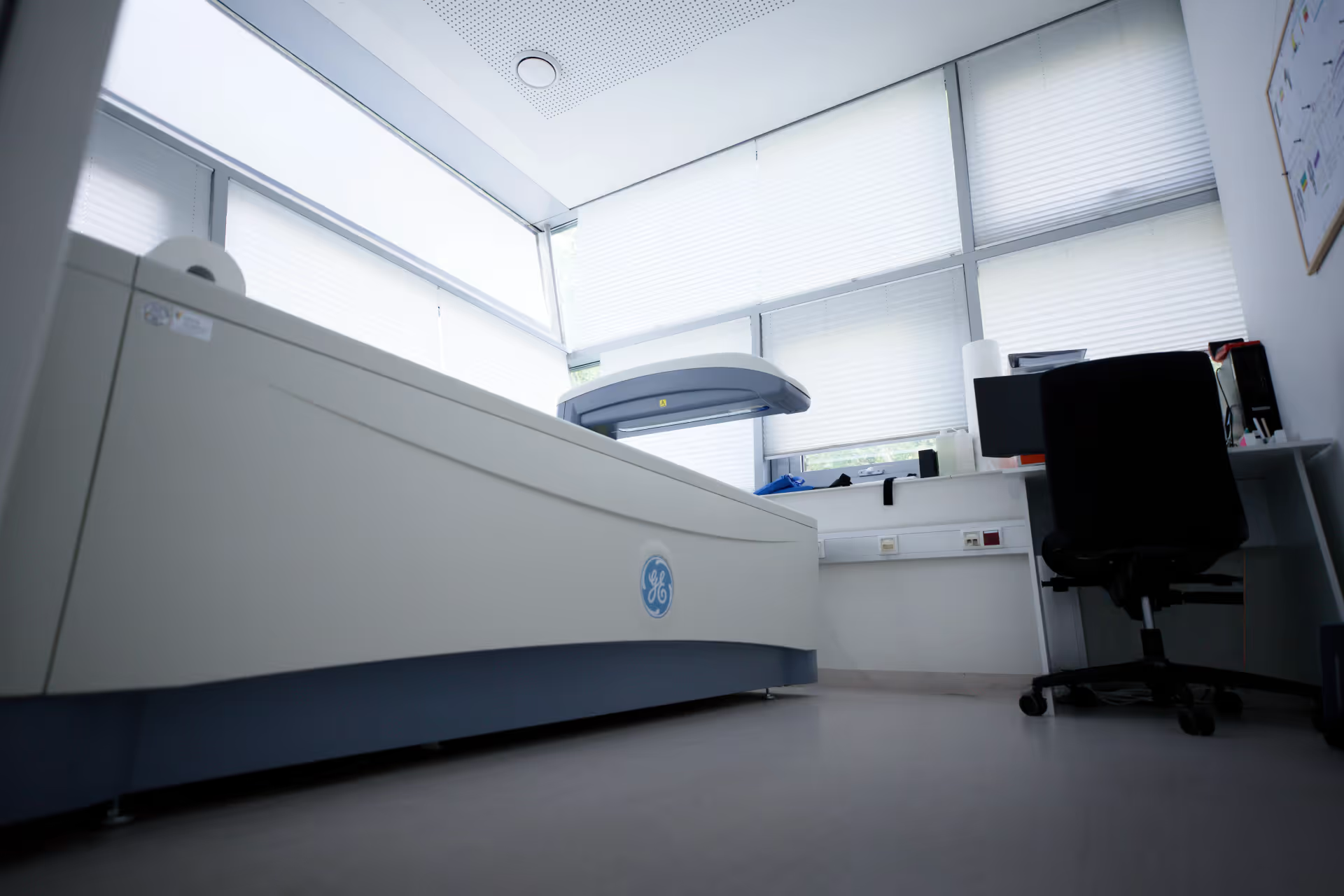
Why have a bone density scan with DEXA?
DEXA – often also written as DXA – is the internationally recognised, scientifically established standard and reference method for measuring bone mineral density. Measurements are usually taken at the lumbar spine and at the hip or femoral neck.
The scan provides standardised values such as the T-score and the Z-score. They help your doctor with diagnosis, assessing fracture risk and monitoring changes over time.
The result is always assessed together with age, risk factors, pre-existing conditions, medications and any previous fractures. A DEXA scan alone does not capture every aspect of bone quality and does not replace an overall medical assessment.
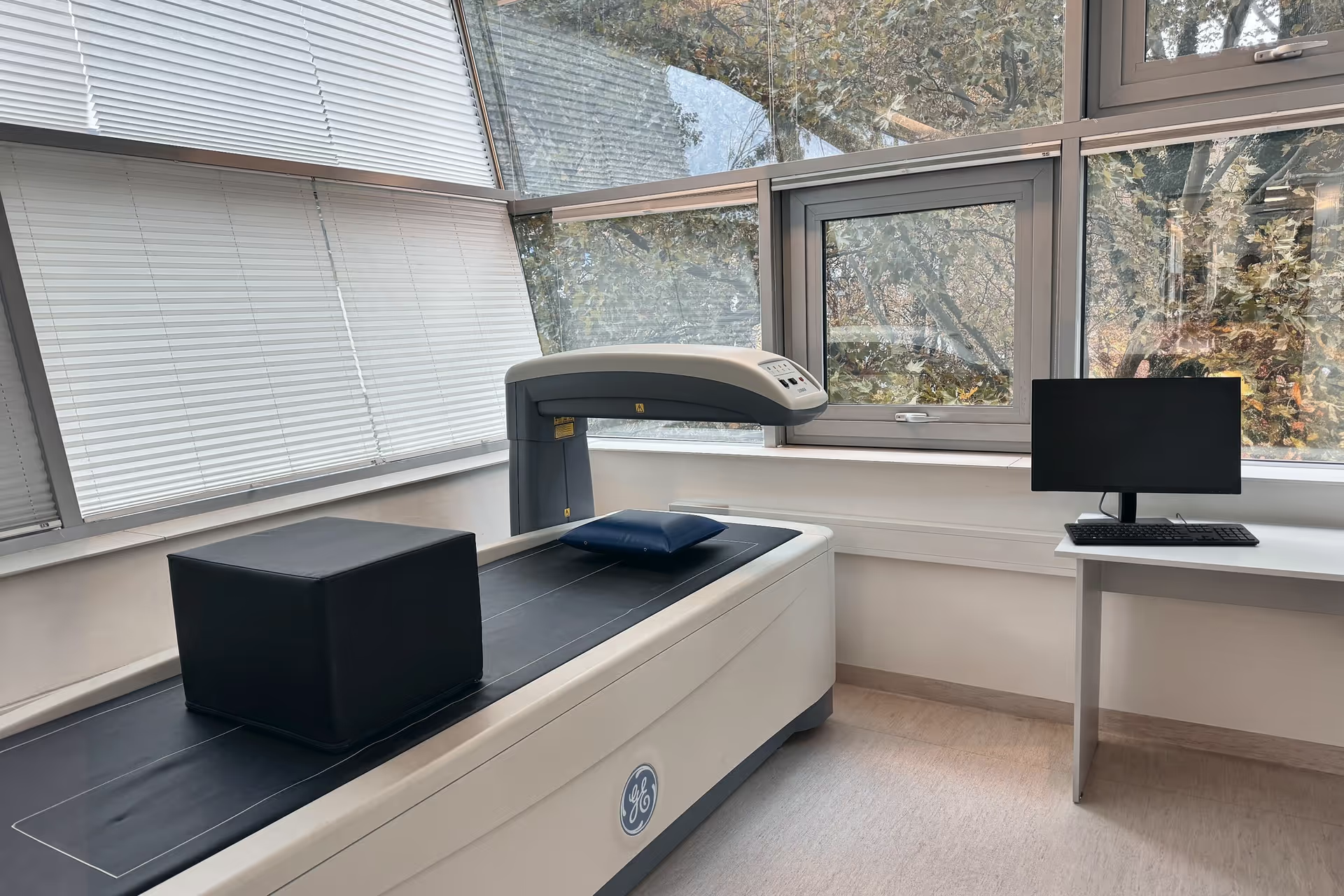
When is a bone density scan recommended?
A bone density scan can be particularly useful in the following situations:
- Women after the menopause with risk factors
- Women aged 65 and over
- Men aged 70 and over
- Younger women and men with relevant risk factors
- A bone fracture from minor trauma (e.g. a fall from standing height)
- A family history of osteoporosis or hip fractures
- Long-term cortisone therapy
- Medications that can promote bone loss
- Early menopause
- Being underweight or having an eating disorder
- Prolonged immobility
- Chronic inflammatory or other conditions that damage bone
- Suspected osteoporosis seen on an X-ray
- Follow-up monitoring for known osteoporosis or ongoing treatment
Not everyone automatically needs a DEXA scan from a certain age. However, from the age of 50, a personal assessment of osteoporosis risk is advisable. If the risk is increased, a bone density scan may be indicated for further assessment.
Who the scan is recommended for, how often follow-up checks are needed and what it costs is summarised in our guide Bone density scan in Graz: who, when, what does it cost?
Quick risk check
9 yes/no questions, based on the risk factors used in the FRAX calculator. This check is not a diagnosis, does not calculate your fracture risk, and does not replace medical advice. Your answers are not saved or transmitted.
The official FRAX calculator (opens in a new window) calculates the probability of a fracture over the next ten years (select “Austria” as the country). Please discuss any result with your doctor.
Costs and cost coverage
ÖGK-insured patients · Private service
ÖGK: €70
For ÖGK members, the DEXA bone density scan is offered as a private service. The price is 70 euros. Depending on individual circumstances, partial or full reimbursement may be possible. Reimbursement cannot be guaranteed.
BVAEB, SVS and KFA Graz
Other health insurance funds: covered as an insurance benefit with a referral
For the other health insurance providers we work with, the examination can be billed as a service paid for by the health insurance fund, provided the required medical referral is available.
Referral and requirements
- BVAEB, SVS and KFA Graz: covered by your insurance only with the required medical referral. Please bring the referral and your e-card with you.
- ÖGK: private service costing €70. Whether and to what extent the ÖGK reimburses the cost depends on your individual circumstances.
- If you pay for the scan privately, you can also book it without a referral.
- Please bring any previous images or earlier bone density results with you, if we don't already have them – they are important for comparing changes over time.
If you are unsure, please check with our practice or your health insurance provider before booking an appointment.
You can pay by cash, card or invoice.
Mammogram and bone density scan in a single appointment
Keeping an eye on breast health and bone health together
As we get older, both breast cancer screening and bone health become increasingly important. At Röntgen am Kai, a mammogram and a DEXA bone density scan can, where possible, be carried out at a joint appointment.
This offer is aimed particularly at women aged 50 and over for whom a bone density scan is medically advisable or wanted as a private preventive service.
You can currently arrange a joint appointment by phone on 0316 840 90 50.
Your benefits
- Just one appointment to book
- Just one trip
- Mammogram and bone density scan at the same practice
- Compact, convenient preventive care
- Clear information on insurance cover, self-pay services and referrals
Insurance, private service and referral
- Screening mammogram
- No referral needed · with e-card · every 2 years – for women aged between 45 and 74 with no symptoms.
- DEXA for ÖGK-insured patients
- Private service costing €70; reimbursement is possible but not guaranteed.
- DEXA for BVAEB, SVS and KFA Graz
- Covered by your insurance with the required medical referral.
AI-supported additional analysis
An additional look at bone health from suitable X-ray images
In people aged 50 and over, suitable X-ray images are additionally analysed for signs of possibly low bone density.
For this, we use the AI algorithm Rho in patients aged 50 and over. Suitable images may be frontal views of the following regions: Lumbar spine, Thoracic spine, Chest, Pelvis, Knee or Hand.
The analysis uses X-ray images that have already been taken. No additional image and no additional radiation exposure is required.
What this finding means
- Rho provides a risk indication of possibly low bone mineral density.
- The result is not an osteoporosis diagnosis.
- An abnormal risk indication may be a reason for a targeted DEXA scan and further medical assessment.
Product information: Rho – 16 Bit (Toronto), distributed by IB Lab (opens in a new window)
What to expect during a bone density scan
Check-in
You check in at reception. Please let us know your health insurance provider and whether you have a referral.
Preparation
Please empty your bladder before the examination. No other special preparation is needed – you don't need to fast. Please remove any metal items within the scan area, such as belt buckles, buttons or zips.
Scan performed lying down
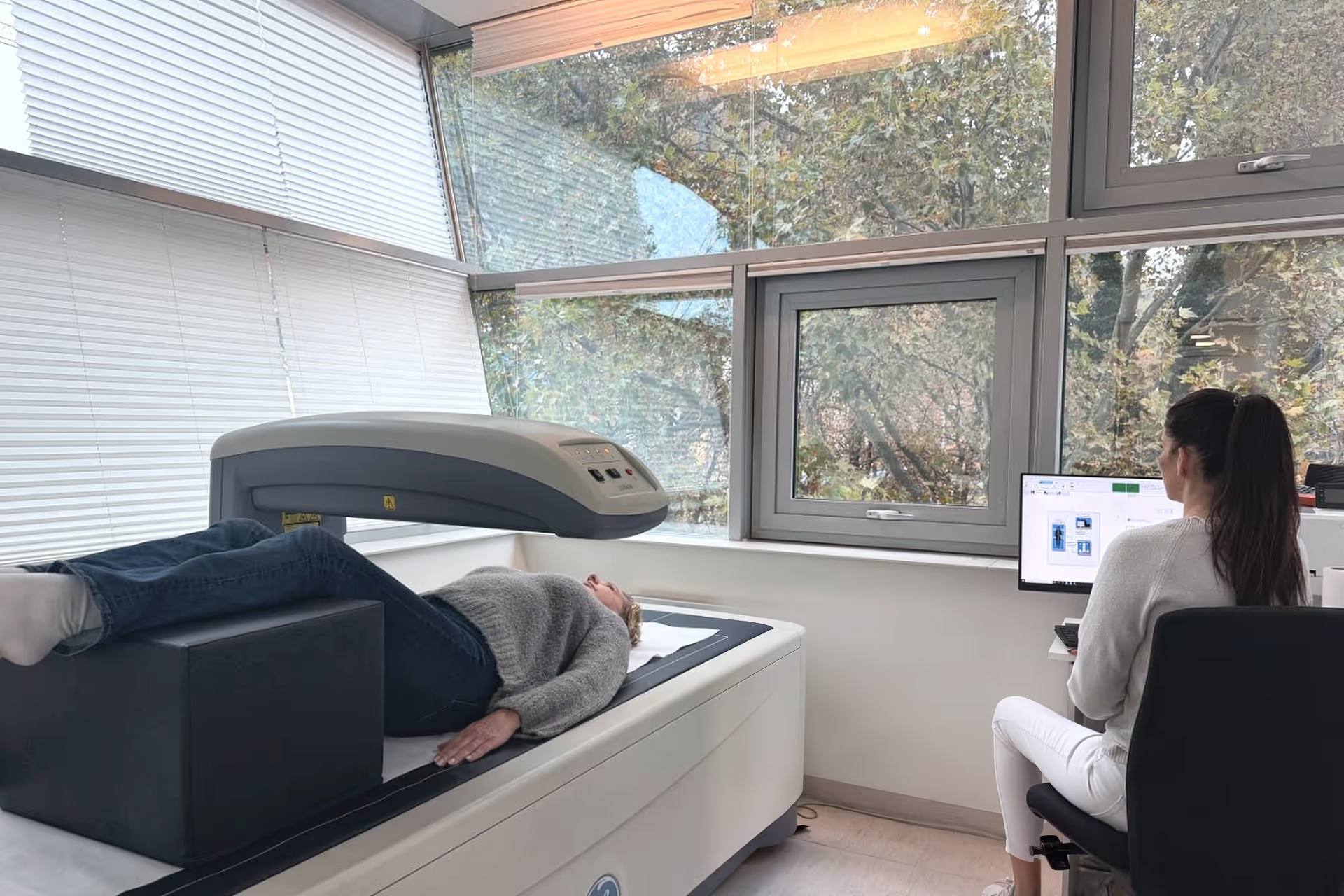
You lie still on your back while the scanning arm passes over your lower spine and hip or femoral neck. The scan is painless and non-invasive.
Schematic illustration: The scanning arm moves over the lumbar spine and hip and measures bone density there – with a very low radiation dose.Video content as text
Bone density scan with DEXA: Lumbar spine · hip · forearm as an alternative. The detector is positioned above the table, with the X-ray source underneath; both move together in the scanning direction over the body.
The scan: Scanning the lumbar spine … and the hip – with a very low radiation dose.
Schematic illustration – not an actual patient scan.
Reporting
The measurements are assessed by specialists in radiology, together with your individual risk factors.
Pregnancy: Please let us know about a possible pregnancy before the examination.
No DEXA scan is carried out directly after an examination with contrast medium. According to the manufacturer, the scanning table is designed for a body weight of up to 159 kg – if your body weight is very high, please check by phone in advance whether the scan is possible.
Result: T-score and Z-score explained simply
- NormalT-score −1 or higher
- Reduced bone density (osteopenia)T-score between −1 and −2.5
- Indication of osteoporosisT-score −2.5 or lower
Schematic illustration – the width of the ranges is not to scale.
T-score
The T-score compares your bone density with the average for young, healthy adults. It shows how far your value differs from this average. It is used mainly for women after the menopause and men aged 50 and over.
According to the World Health Organization's definition, a T-score of −1 or higher is considered normal, between −1 and −2.5 indicates reduced bone density (osteopenia), and −2.5 or lower suggests osteoporosis.
Z-score
The Z-score compares your bone density with people of the same age and sex. It is particularly meaningful for younger women before the menopause, men under 50, and children.
Depending on the clinical question, the report may include further details, such as an assessment of fracture risk (FRAX).
- The measurement result alone is not a treatment recommendation.
- It is always assessed together with your clinical risk factors – such as age, pre-existing conditions, medication and previous fractures.
- Whether treatment makes sense is something to discuss with your doctor.
How to read your DEXA scan report
Browse through anonymised example reports from our practice. Highlighted areas explain what each piece of information means.
T-score in simple terms
- T-score −1 or higher:normal
- T-score between −1 and −2.5:low bone density (osteopenia)
- T-score −2.5 or below:Osteoporosis according to the WHO definition
This classification does not apply to all age groups. It is intended for women after the menopause and men aged 50 and over – for younger adults, the Z-score is usually more relevant. The diagnosis is always made by a specialist in radiology – never by the software alone.
No diagnosis from a single number
The diagnosis and fracture risk are not based on a single number. Age, previous fractures, medication, medical conditions and the regions measured are all taken into account by the doctor. Osteoarthritis, calcifications or changes in the vertebrae can increase the values at the lumbar spine.
Forearm
In these example reports, the forearm was not measured. According to the ISCD, it is only added in certain situations – for example, if the spine or hip cannot be measured or assessed, or in cases of an overactive parathyroid gland. In that case, a defined section of the radius on the non-dominant arm is used.
These values are from an example and are not an assessment. Please discuss your personal results with your doctor.
Sources for the explanations
- International Society for Clinical Densitometry (ISCD). 2023 ISCD Official Positions – Adult. Adopted on 24.08.2023 (English). iscd.org/official-positions-2023/ (opens in a new window)
- Dachverband Osteologie (DVO). Guideline on the prevention, diagnosis and treatment of osteoporosis in postmenopausal women and men aged 50 and older, Version 2.1, 2023. leitlinien.dv-osteologie.org/ (opens in a new window)
- Gupta P, Cherian KE, Kapoor N, Paul TV. Aortic Calcification Artifact Causing Spuriously High Bone Mineral Density in the Lumbar Spine. AACE Clinical Case Reports. 2021;7(4):284–286. doi.org/10.1016/j.aace.2020.12.007 (opens in a new window)
DEXA is the scientifically established standard method for measuring bone density. The examination is quick, non-invasive and involves a very low radiation dose.
From the age of 50, you can book the bone density scan together with a mammogram in a single appointment – currently by phone. Mammogram and bone density scan together
Frequently asked questions about bone density scans
DEXA (also known as DXA, 'Dual-Energy X-ray Absorptiometry') is an X-ray measurement with a very low dose. It determines the mineral content of the bone – usually at the lumbar spine and the hip or femoral neck. The result helps to detect osteoporosis and assess fracture risk.
DEXA is the scientifically established standard and reference method for measuring bone mineral density. The measurements are standardised (T-score, Z-score), internationally comparable and suitable for diagnosis, risk assessment and follow-up monitoring.
For example, for women after the menopause with risk factors, for women aged 65 and over and men aged 70 and over, after a fracture caused by minor trauma, during longer-term cortisone treatment, or with conditions that can weaken the bones. Not everyone automatically needs a DEXA scan from a certain age – but from age 50, a personal assessment of osteoporosis risk is worthwhile.
A referral is required for billing as a service covered by BVAEB, SVS and KFA Graz. For ÖGK members, the scan is a private service. If you pay for the scan privately, you can also book it without a referral. Please check with the ÖGK or with us beforehand whether you need a referral for possible reimbursement from the ÖGK.
For ÖGK members, the DEXA bone density scan is offered as a private service. The price is €70.
Depending on your individual circumstances, partial or full reimbursement may be possible. Reimbursement cannot be guaranteed. If in doubt, please check with the ÖGK in advance.
With BVAEB, SVS and KFA Graz, the examination can be billed as a covered service if the required referral is provided. If you are unsure, please check with us or your insurance provider before booking an appointment.
You lie still on your back on an examination table while a scanning arm moves over your lumbar spine and hip. Any metal items in the scan area – such as belt buckles, buttons or zips – may need to be removed. You should empty your bladder before the examination. Otherwise, no special preparation is needed; you don't need to fast.
No. The scan is painless and non-invasive – there's no injection and no tube. You simply lie still on the table.
DEXA uses a very low X-ray dose. A typical scan is roughly in the range of a few microsieverts. As an illustrative comparison, about 0.001 mSv corresponds to roughly three hours of natural background radiation. The exact value depends on the device and examination protocol. This means the radiation dose is significantly lower than with a standard X-ray. As it still involves X-ray radiation, please let us know beforehand if you may be pregnant.
The T-score compares your bone density with the average for young, healthy adults. It is mainly used for women after the menopause and men aged 50 and over. The Z-score compares your value with people of the same age and sex – it is particularly informative for younger people. Both values are always assessed by a doctor together with your risk factors.
There's no fixed interval that applies to everyone. Whether and when a follow-up makes sense depends on your baseline result, your risk factors, any ongoing treatment and the medical question being asked. Your doctor will decide this with you.
Yes, wherever possible we carry out the mammogram and bone density scan at a single appointment. At the moment, the easiest way to book a combined appointment is by phone. Please let us know your health insurance provider and whether you have a referral.
In people aged 50 and over, suitable X-ray images are additionally analysed for signs of possibly low bone density. The Rho software uses images that have already been taken – with no additional imaging and no extra radiation. It provides a risk indicator for possibly low bone mineral density, but not a diagnosis.
No. A Rho result is not a diagnosis of osteoporosis. An abnormal result may be a reason to carry out a targeted DEXA scan and further medical assessment. Bone density itself is measured using DEXA.
A DEXA scan is generally not carried out during pregnancy, even though the dose is very low. Please let us know before the examination if you are or might be pregnant – we will then discuss the next steps with you.
Appointment, practice and further information
Arrange a DEXA appointment in Graz
Book your bone density scan online or call us. Price for ÖGK members: €70 (private service). BVAEB, SVS and KFA Graz: covered by your health insurance fund with a referral.
Opening hours: Mon – Thu 08:00–17:00, Fri 08:00–13:00
Examinations and consultations with us can be conducted in German or English.