
Osteoporosis causes no symptoms for a long time. Often it's only noticed when a bone breaks after a minor fall. A bone density scan can show how stable your bones are before that happens. In this article, you'll find out who should consider having the scan, when a follow-up is due, and what it costs at Röntgen am Kai in Graz.
What is a DEXA bone density scan?
DEXA (also called DXA) is a very low-dose X-ray scan. It measures the mineral content of the bone, usually at the lumbar spine and hip. The result helps to detect osteoporosis and estimate fracture risk. The method is the scientifically established standard and reference method for measuring bone mineral density.
DEXA uses a very low X-ray dose. A typical scan is roughly in the range of a few microsieverts. As an illustrative comparison, about 0.001 mSv corresponds to roughly three hours of natural background radiation. The exact value depends on the device and examination protocol.
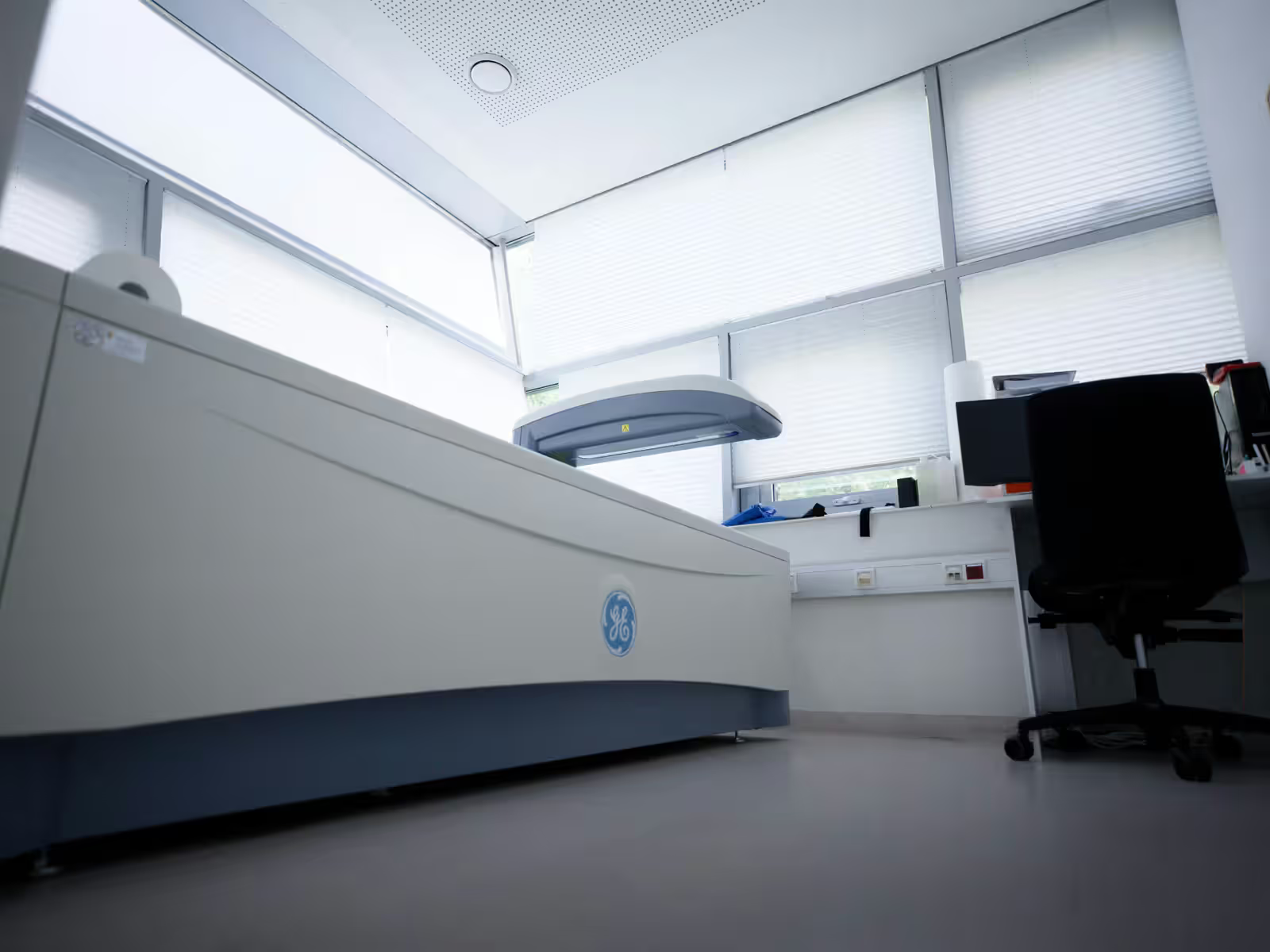
You lie still on your back while a scanning arm passes over your lumbar spine and hip. The scan is painless, with no injection and no tube. It takes about 10–15 minutes.
Who is the scan recommended for?
Not everyone automatically needs a bone density scan from a certain age onwards. However, from age 50, it's worth having a doctor assess your personal osteoporosis risk. If the risk is increased, experts recommend a scan for further assessment. Typical reasons include:
- Women after the menopause with risk factors
- Women aged 65 and over and men aged 70 and over, if risk factors for osteoporosis are present
- a bone fracture from a minor cause, such as a fall from standing height
- long-term use of cortisone or certain hormones
- conditions that can weaken the bones
- osteoporosis or bone fractures that run in the family
Before age 50, osteoporosis is rare in healthy people. A routine scan is not recommended at this stage. You can get a rough idea of your risk with the risk check on our bone density scan page; your doctor will assess the result.
How often are follow-up scans needed?
There's no fixed interval that applies to everyone. Whether and when a follow-up scan makes sense depends on your baseline result, your risk factors, and any ongoing treatment. The German-language guideline of the Dachverband Osteologie (DVO) provides guidance on this:
- Without osteoporosis treatment: The interval depends on the result of the previous scan. With a T-score above −1.0, a repeat scan is usually not needed for more than 5 years.
- If something changes: If a new condition develops or treatment with cortisone begins, an earlier follow-up scan may be needed.
- After starting or changing osteoporosis treatment: A follow-up bone density scan should take place before 5 years have passed.
Your treating doctor will determine the right time for you. For comparison, it's helpful to carry out the follow-up scan using the same method.
What does the bone density scan cost?
For ÖGK members, the DEXA bone density scan is offered as a private service. The price is 70 euros. Depending on individual circumstances, partial or full reimbursement may be possible. Reimbursement cannot be guaranteed.
For the other health insurance providers we work with, the examination can be billed as a service paid for by the health insurance fund, provided the required medical referral is available. This includes BVAEB, SVS and KFA Graz.
- ÖGK: self-pay for €70
- BVAEB, SVS and KFA Graz: covered by health insurance with the required referral
- Without a referral: If you pay for the scan privately, you can also book it without a referral.
If you are unsure, please check with our practice or your health insurance provider before booking an appointment.
Book appointment online
You can book the bone density scan online (opens in a new window) or arrange an appointment by phone on 0316 840 90 50. Where possible, we carry out mammograms and bone density scans at the same appointment. At the moment, the easiest way to arrange this is by phone.
Preparation and what to bring
No special preparation is needed, and you don't need to fast. You should empty your bladder before the scan. Please remove any metal items in the scan area, such as belt buckles, buttons or zips, if necessary.
- Your e-card
- your referral, if the scan is billed to your insurer (BVAEB, SVS and KFA Graz)
- previous bone density results and scans, if we don't already have them – they're important for comparing changes over time
Please let us know before the examination if you might be pregnant. DEXA scans are generally not performed during pregnancy.
What happens after the scan?
The result is given as a T-score and Z-score, and is always assessed together with your age, risk factors, pre-existing conditions, medications and any previous fractures. You can find out what the values mean and how a report is structured on our bone density scan Graz page. Your doctor decides on any treatment.