
Bone health in older age
Healthy ageing – maintaining bone and muscle mass
Strong bones and sufficient muscle strength and mass help you walk safely, stand steadily and stay independent in everyday life. Here you can find out what matters and which examination answers which question.
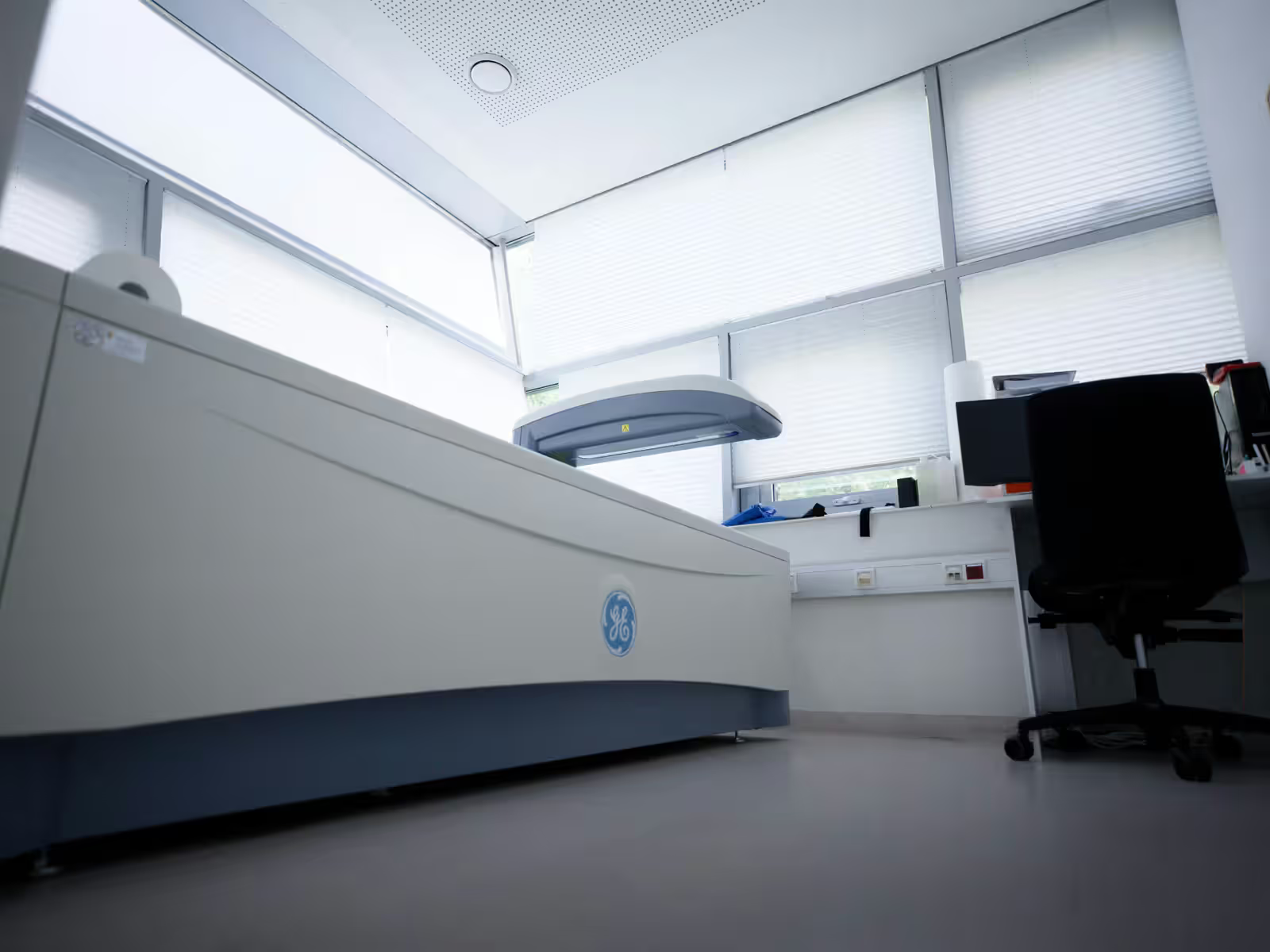
Bones and muscles as you age: what matters
Bones and muscles are closely linked: strong muscles protect against falls, and strong bones protect against fractures.
Osteoporosis and fracture risk
With osteoporosis, bone loses density and stability. Fractures – for example of the hip, spine or wrist – can then occur even with minor strain.
Reduced muscle mass and strength
Muscle mass and strength gradually decline with age. This can make walking, climbing stairs and getting up more difficult.
Exercise and strength training
Regular exercise and targeted strength training help maintain muscle and bone – at any age and suited to your own capacity.
Energy and nutrients
Muscles and bones need enough energy, protein and minerals. Your doctor or a dietitian can advise you on what you personally need.
Repeated falls
Falls often have several causes, such as strength, balance, eyesight or medication. They should be assessed by a doctor.
Inactivity and hospital stays
Prolonged bed rest or illness can quickly reduce muscle mass and strength. Afterwards, it's worth rebuilding them in a targeted way.
Unintended weight loss
If you lose weight without meaning to, the cause should be assessed by a doctor – regardless of any measurement.
Warning signs
If you have had falls, fractures, significant weakness or unintentional weight loss
Please have these symptoms assessed by your GP first. A DEXA scan alone cannot determine the cause. However, it can be one part of further investigations if your doctor considers this useful.
Two examinations, two questions
Both examinations use DEXA but answer different medical questions. You can book both individually or as a combined appointment (€120).
1. DEXA bone density scan
Question: How dense and strong are my bones?
The scan of the lumbar spine and hip assesses bone mineral density. It is used for the early detection and monitoring of osteoporosis and helps to estimate fracture risk.
ÖGK: self-pay €70; other insurers according to their respective requirements.
2. DEXA body composition scan
Question: How much fat and lean mass do I have, and where?
The whole-body scan measures fat mass and lean soft-tissue mass – as an approximation for muscle mass – separately for arms, legs and trunk. Muscle strength is not measured.
Self-pay €70, no referral needed.
If you already suspect significant muscle loss, read on at Muscle loss and sarcopenia.
Bone health in older age affects men too
Osteoporosis is often seen as a women's issue, but men also lose bone and muscle mass over the years. The International Society for Clinical Densitometry (ISCD) recommends a bone density scan for men from age 70, and for younger men if risk factors are present – such as a previous fracture, low body weight, certain medications or conditions.
Relevant health goals
Medical sources
- International Society for Clinical Densitometry (ISCD): Official Positions – Adult, 2023 edition. View source (opens in a new window)
- Cruz-Jentoft AJ, Bahat G, Bauer J, et al. Sarcopenia: revised European consensus on definition and diagnosis (EWGSOP2). Age and Ageing 2019;48(1):16–31. View source (opens in a new window)
This page is for general information only and does not replace medical advice.
Choose the right examination
Bone density and body composition – individually or as a combined appointment (€120).
Bone density scan
Bone mineral density, osteoporosis
Body composition scan
Fat mass and lean soft tissue mass
Opening hours: Mon – Thu 08:00–17:00, Fri 08:00–13:00